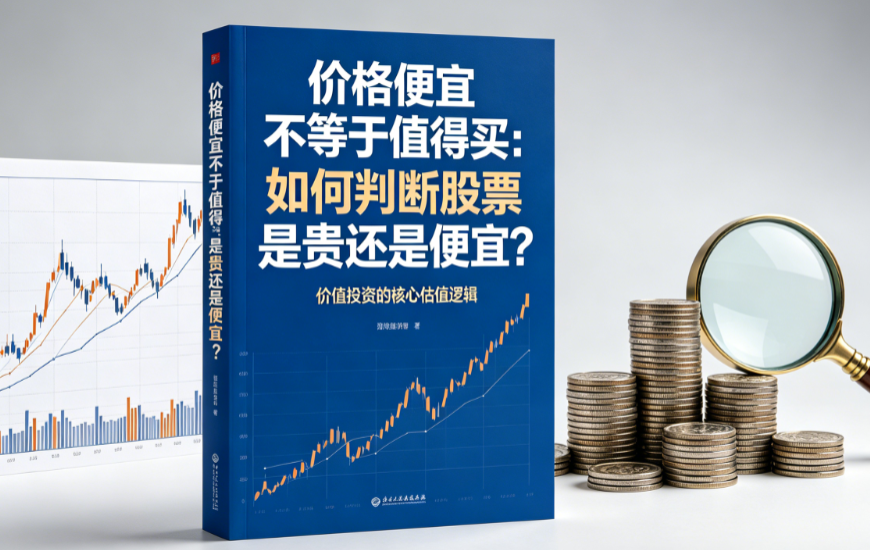
You see another stock trading at 800 dollars a share and think it's too expensive to touch. That's how many people choose stocks: buy the cheap ones, avoid the expensive ones. But that logic is flawed from the start.
Investing is not shopping at a wet market. You're not picking the cheapest cabbage; you're buying a company's ability to earn money in the future.
A stock at 15 dollars can still be expensive if the company barely makes any profit. A stock at 800 dollars can still be cheap if the company's earnings keep growing.
Today, let's make one thing clear:how do you tell whether a stock is expensive or cheap? Don't look only at price; look atvalue. Once you understand this difference, your investing is already ahead of many people who only stare at share price.
Price and value are not the same thing
First, the most basic idea that many people mix up:price and value are different.
-
Price is what you pay (price)
-
Value is what you get (value)
You buy a coat for 3,000 dollars. That 3,000 is the price. But if you wear it every day for three years and it still holds up, the value it gives you may far exceed 3,000.
On the other hand, you buy a T-shirt on sale for 100 dollars. Super cheap. But after one wear it wrinkles badly, after one wash it shrinks, and then it sits in your closet forever. The price was 100, but the actual value to you may be close to zero.
Stocks are the same. You shouldn't only ask whether a stock is expensive. You should ask: is the stock'svalue good compared with itsprice?
Value investing means buying stocks whose value is undervalued
When people hear "value investing," they think it sounds sophisticated. But most people's understanding is actually too shallow. They think value investing means buying cheap stocks—low-priced, heavily fallen, or unwanted names.
Not quite.
Value investing means buying stocks whose value is undervalued. Undervalued value and low price are completely different things.
-
If a company's share price falls from 500 to 100, it looks 80% cheaper. But if its earnings also fall 90%, then 100 may not be cheaper than 500.
-
Conversely, if a company's share price rises from 500 to 800, it looks 60% more expensive. But if earnings triple over the same period, 800 may actually be cheaper than 500.
So don't let price fool you. Price is the surface;value is the essence.
How do you measure a stock?
The stock market has dozens of indicators—P/B, P/E, EV, EBITA, ROE, ROA, dividend yield... just the jargon alone is enough to scare people off.
You don't need to learn everything at once. If you understand just two, you'll already avoid many beginner mistakes.
The first is P/B, price-to-book ratio
-
P stands for price
-
B stands for book value
-
R stands for ratio
What does it mean? A company's assets minus all liabilities leaves itsbook value. In accounting terms, that's how much shareholder equity the company has left. Then compare the market value of the stock to that book value.
-
If a company's book value is 10 billion and its market cap is only 8 billion, the P/B is 0.8x. That may mean the market is very pessimistic about asset quality, future earnings, or the industry's outlook.
-
If a company's book value is 10 billion and its market cap is 30 billion, the P/B is 3x. That means the market isn't just pricing the current assets; it's also pricing in future profit potential.
The lower the P/B, in theory, the cheaper the valuation. But that's not absolute. Some companies have low P/B because their assets are poor quality, or because they truly won't make money in the future.
So P/B only makes sense when compared with peers. For example, if two semiconductor companies have P/B ratios of 1.5x and 4x, and their business structure, profitability, and outlook are similar, the first one may be relatively undervalued.
The second is P/E, price-to-earnings ratio
-
P is still price
-
E is earnings per share
-
R is ratio
What does it mean? How much does the company earn in a year, and how many times that profit is the stock price?
Suppose a company has a market cap of 100 billion and annual net profit of 10 billion, then the P/E is 10x. Very roughly, assuming earnings stay unchanged and ignoring dividends, interest rates, and time value, the market is willing to pay 10 years of earnings to buy the company.
The lower the P/E, the less you pay relative to earnings, which sounds cheaper. But like P/B, a low P/E doesn't automatically mean good. Some companies have low P/E because the market expects earnings to fall.
So P/E should also be compared with peers.
One metric looks at assets (P/B), the other at earnings (P/E). Understanding these two is enough to start building your judgment; you don't need to throw yourself into a pile of complex formulas right away.
Some people will say, "That's too simple, isn't it?" Yes—it really is that simple. Investing doesn't need to be overcomplicated at the beginning. Complexity doesn't equal correctness. A simple framework executed well is far better than a complicated framework done badly.
What is a leading stock?
Next, a concept many people don't understand: what is aleading stock?
In every industry, there are usually one or two companies leading the pack. It's not just because they're the biggest; it's because their share price, earnings, and market position best represent the industry's direction. That's a leading stock.
How do you find a leading stock?
There's a very simple entry point: look at the industry'sETF.
For example, if you're interested in semiconductors, find a semiconductor ETF and open its holdings list. The stocks with the highest weights are usually the companies the market cares about most, and they are the first clue to identifying the leaders.
What is an ETF? It stands for Exchange Traded Fund. In essence, it's a fund holding a basket of stocks, but it is designed to trade on an exchange like a stock.
Each ETF usually discloses on its website which stocks it holds and how much weight each one has. That's public information. You don't need any special channel—just search the ETF name online.
For example, if you check a Taiwan semiconductor ETF, the top-weighted holdings will usually include TSMC. Then TSMC can be seen as one of the most important leading stocks in Taiwan's semiconductor industry.
If you look at a defense-related ETF, the company with the highest weight and the strongest representation of the industry's trend is worth your deeper research.
It's that simple. You don't need to search blindly through thousands of stocks. TheETF already did the first round of screening for you. You only need to see what it picked and then judge whether those companies really represent the industry's direction.
Is it better to just buy ETFs and skip individual stocks?
It depends.
-
If you're unfamiliar with an industry, don't have time to research, and don't want to track it closely, buying an ETF for that industry is a reasonable choice. Especially large index ETFs like Taiwan 50 trackers 0050 or 006208; for beginners, these are far more stable than randomly buying stocks.
-
But if you already know which company is the industry's leader and understand it reasonably well, buying the stock directly may be more focused and efficient than buying an ETF.
Why? Because an ETF holds a basket of stocks. If the leader rises 20% but the other ten-plus holdings don't move or even fall, your ETF may only rise 8% overall. You diversify risk, but you alsodiversify returns.
There's something many people don't understand:buying more stocks does not mean you'll earn a higher return.
Baseball analogy: does stepping up to the plate more times automatically mean more hits? No. The number of hits depends on your batting average. Investing is the same—buying more stocks doesn't mean making more money. Your return depends on the quality of your picks, not just the quantity.
If you spread your money across 100 stocks and one of them hits limit up, your account still moves only a tiny bit. Concentrating capital on a few names you truly understand and truly trust may have a much bigger effect.
Of course, if you have no confidence at all, then buy an index ETF. That's not embarrassing—it's a rational choice because you admit your limits and make a more prudent decision within your capabilities.
You don't need to finish all your homework before investing
Here's a key idea:you don't need to finish all your homework before investing.
What do many people do when they plan to start investing? They go to the bookstore and buy a pile of books—Buffett's investing philosophy, technical analysis basics, macroeconomics, Peter Lynch's stock-picking strategy, how to read candlestick charts... five or six books piled on the desk, and then they start "studying."
Three months later, the books aren't finished, and not a single stock has been bought.
It's like wanting to learn swimming, so you borrow every swimming book from the library, read them at home for three months, then jump into the pool and find you still sink.
Investing is not an exam; investing is live practice. You don't need to learn everything first. You need to start, then meet problems, solve them, and learn along the way.
-
You buy a stock, and it falls. You ask why, research it, and discover the company's main product price declined. You learn one lesson: stock prices are related to product prices.
-
That lesson wasn't memorized from a book; you learned it by actually bearing market volatility. That kind of learning is often much more effective than reading only and never acting.
So don't just do homework—do small-scale live practice. Start with a small amount of money, research whenever problems arise, and remember the answers. Step by step, this is far more effective than doing nothing but reading at home.
What information really matters for the stocks you own?
Now an extremely important skill:what information really matters for the stocks you own.
Suppose you bought TSMC. One day you see the headline: "The U.S. Federal Reserve decides not to cut rates for now." You panic: "Oh no, if rates don't come down, the market will drop, right?" You check the app and TSMC is down 2%. You freak out—should you sell?
Hold on. Ask yourself one question first:does the Fed not cutting rates directly change how much TSMC will earn next year?
What drives TSMC's earnings?
-
Advanced-node utilization
-
Demand for AI chips and high-performance computing
-
Customer order volumes
-
Foundry pricing
The Fed's rate decisions can affect liquidity and valuation sentiment, but they don't necessarily change these core variables directly.
So what's the more rational reaction? If the Fed doesn't cut rates but TSMC's orders keep rising and advanced-node demand stays strong, a short-term price drop caused by broad news may actually be a chance to reassess adding to the position.
On the other hand, if TSMC's customers start cutting orders, advanced-node yields have issues, and pricing weakens, then even if the Fed cuts rates and the stock bounces temporarily, you should re-check your investment thesis.
The core idea is just one thing: find the variable most directly tied to the company's earnings, and watch that variable. Don't let other noise mislead your decisions.
-
For TSMC, watch advanced-node demand, utilization, orders, and pricing
-
For display makers, watch panel prices
-
For shipping companies, watch freight rates
-
For financials, watch spreads, lending quality, and asset quality
Different companies have different core variables. If you own a company's stock, find out what its core variable is and watch that first.
There are hundreds of news items every day. You don't need to read them all. You only need the few that relate to your holdings' core variables. Everything else is noise, and too much noise will only lead to bad decisions.
Investing in a familiar industry can actually go wrong more easily
Here's an interesting phenomenon:investing in an industry you know well can actually go wrong more easily.
You work in tech and know the semiconductor industry very well. You know which company's yields are good, which management has problems, and which new product isn't as good as the outside world says. You think you have an information edge and know the industry better than retail investors.
Then you make an investment decision and lose money. Why?
Because you know too much, until you start becomingarrogant.
You know one manager is unreliable. You know a component in one product has yield issues. Based on those fragmentary observations, you develop a strong bias against the company. But the problem is that stock prices are usually not decided by internal trivia alone. They more often reflect the market's expectations of the company's future earnings.
You know that manager is no good, but the market may not care. The market cares whether next quarter revenue hits a new high, whether gross margin holds up, and whether orders keep growing.
It's like a beauty pageant. You know all the contestants, and you know who's bad-tempered, who's hard to deal with, and who had cosmetic surgery. But the judges don't know that, and neither do the audience. They only see the performance on stage. The winner may end up being the person you thought least deserved it.
Investing is the same. Your industry knowledge can sometimes make you overemphasize isolated problems and make judgments against the market trend. And in the stock market, people who keep fighting the trend usually don't have an easy time.
So investing in a familiar industry isn't impossible, but you need to be careful about one thing:don't become arrogant just because you know more than others. The market doesn't care how many details you know; it cares about the numbers.
When to use ETFs vs. individual stocks
Many people treat ETFs like a cure-all: if you don't understand anything, buy ETFs; don't understand semiconductors, buy a semiconductor ETF; don't understand financials, buy a financial ETF; don't understand AI, buy an AI ETF.
But ETFs have scenarios where they fit and scenarios where they don't.
The best ETF scenario is when you want exposure to an index or an entire market but can't buy the index directly.
For example, if you think Taiwan's large-cap leaders have long-term upside but you can't buy the Taiwan 50 index directly, what do you do? Buy 0050 or 006208. These ETFs track the Taiwan 50, which is the 50 largest listed companies in Taiwan by market cap. By buying them, you're effectively buying a basket of Taiwan's core large-cap companies at once. In that case, an ETF is a very good tool, because what you want isn't one company—it's the whole basket of large-cap leaders.
But if you want to invest in semiconductors, and you know the leader is TSMC, why take a detour and buy an ETF that includes TSMC plus a dozen other companies you may not even like?
Buying the individual stock may offer more concentrated upside, because your capital is placed in the name you like most and isn't diluted by the others. But on the flip side,the risk is also more concentrated. If you're right, the return is more visible; if you're wrong, the volatility is more direct.
So ETFs are not universal. They're a good tool, but you have to use them in the right context.
-
Beginners starting with index ETFs are perfectly fine.
-
As your experience grows and your understanding of a specific industry deepens, gradually shifting from ETFs to individual stocks is a reasonable upgrade path.
Don't rush, but don't stay forever in the state of "it's okay to understand nothing." Growth is part of investing.
Don't touch what you don't understand
What about areas you completely don't understand? Some people ask whether gold can be invested in, whether crypto can be invested in, whether commodities can be invested in.
The answer is:if you don't understand the valuation logic of that field, don't rush to touch it.
Buffett has long avoided most tech companies he didn't understand. Only after he truly understood certain companies' business models and cash flow characteristics did he heavily buy Apple.
You don't need to understand every investment product. You only need to make good decisions within what you understand. Don't touch what you don't understand—that's not cowardice, that'sdiscipline.
Many people lose money not because they aren't smart enough, but because they touch things they don't understand. A friend says it's good, so they buy; a headline says it will rise, so they chase; they don't even know what they've bought. Then they blame the market or the government when they lose.
Of course, it's not the market's fault—you stepped outside your circle of competence.
-
If you're in tech, start by researching tech stocks.
-
If you're in finance, start by researching financial stocks.
-
If you're in manufacturing, start by researching manufacturing stocks.
Find opportunities in fields you know relatively well. You don't need to know everything. You don't need to compare with others about who knows more fields. Just keep improving in your own field.
Don't compare
A message for all investors:don't compare. Comparison is the deadliest poison in investing.
You buy Stock A and it rises 20%, so you're happy. Then you see a friend bought Stock B and it rose 100%, and all your happiness disappears instantly. What do you do? Sell A and chase B. Then B starts falling the same day, and you're stuck at the top.
Comparison makes you abandon your plan and make impulsive decisions.
Please like, subscribe, share, and support this channel. In 10 or 20 years, the gap will become very obvious.
You don't need to be a master investor. You only need your assets to grow faster than inflation. One of the simplest ways is tobuy index ETFs and hold them for the long term.
-
Relatively little need to pick stocks
-
No need to watch the market every day
-
No need to understand technical analysis from day one
-
Invest a fixed amount each month, and don't let short-term volatility scare you away
Let time and compounding work for you. Suppose you invest 100,000 at 10% annual return for 30 years; it becomes about 1.7 million. That doesn't require genius or perfect prediction. What it requires isdiscipline, time, and the mental readiness to endure volatility.
But if you're willing to spend more time learning and gradually move from index ETFs to sector ETFs and then to individual stocks, you may pursue higher returns. You also need to accept more concentrated risk.
The learning path
The path is this:
-
Step 1: Buy an index ETF and feel the market's temperature.
-
Step 2: Learn to read P/B and P/E, and compare valuations among companies in the same industry.
-
Step 3: Find the leading stock in an industry you know, graduate from ETFs, and start researching individual stocks.
-
Step 4: Learn to judge what information really matters for the company you own, and filter out noise.
Each step is not hard, but each step takes time. Don't try to skip grades. Don't try to do everything at once. Investing is a lifelong thing—you have the time.
Summary
Today we covered a lot, but the core is just a few things:
-
Price and value are different. A cheap stock is not always good, and an expensive stock is not always bad. What matters is not the absolute price, but the comparison between value and price.
-
To measure value, start with two indicators: P/B for assets and P/E for earnings. Compare with peers to make it meaningful.
-
You don't need to hunt blindly for leaders: look at ETF holdings. The biggest weights that best represent the industry's direction are the key clues.
-
Know the core variable of the company you hold, and prioritize news related to that variable. Everything else is noise.
-
ETFs are suitable for index and basket-style market investing. But if you already know the leader and are willing to take stock-specific risk, researching individual stocks may be more efficient.
-
Don't rush into fields you don't understand. Doing well within what you know is enough.
-
Don't compare. Comparison is the deadliest poison in investing.
-
Investing is not an exam. You don't need to finish all homework before starting. Begin with a small amount and learn as problems appear.
-
Start with index ETFs and progress slowly. Each step is not hard.
You don't need to be a genius. You just need to start.