



Sector Analysis
2026-08-23 06:04
185 Read
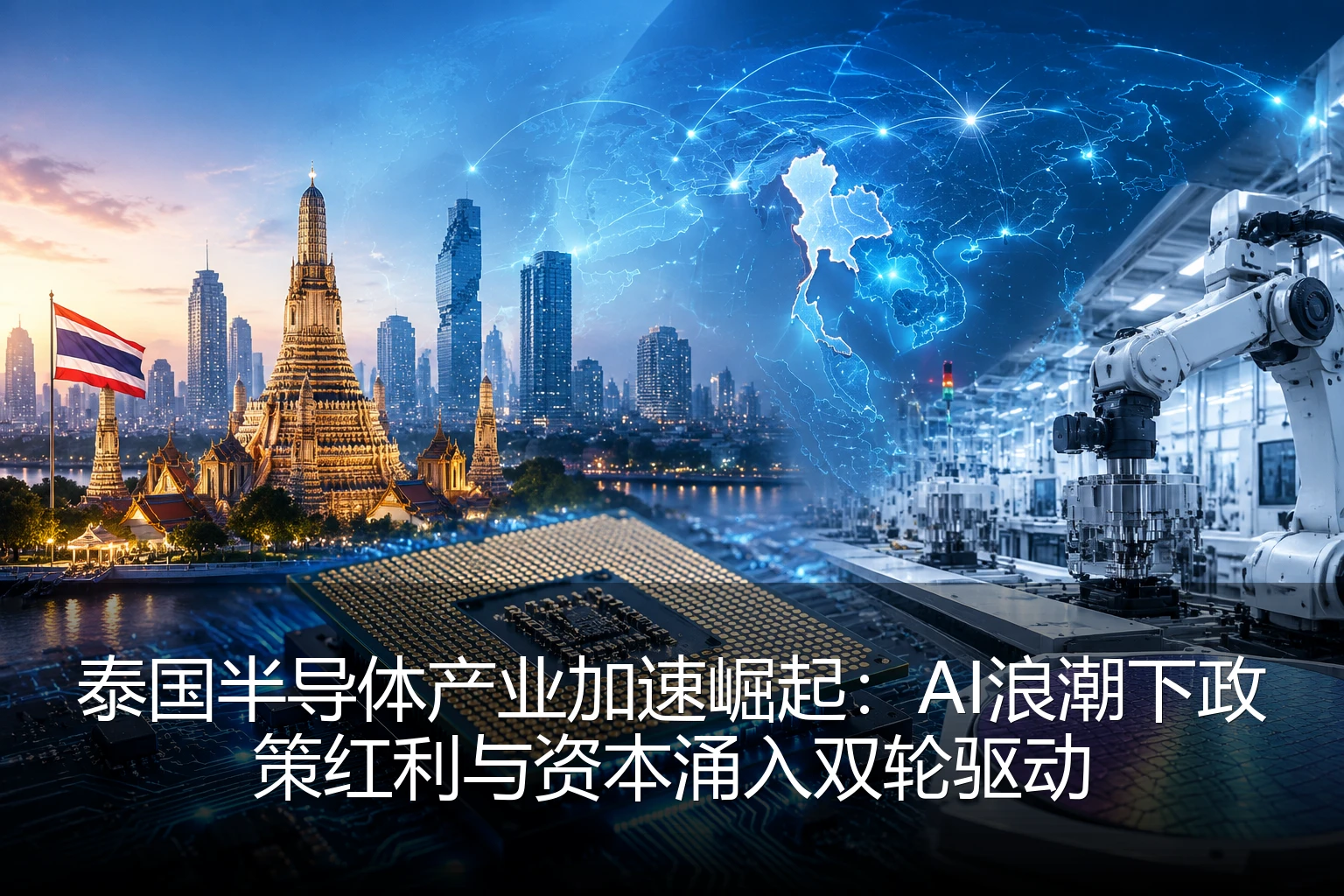
Thailand Semiconductor Industry Accelerating Rise: Dual Driver of Policy Dividend and Capital Inflow Under the AI Wave
Summary:In 2026, the global semiconductor industry will face structural opportunities driven by the demand for AI and automotive chips. Thailand, leveraging policy support, locational advantages, and industry chain layout, is becoming a core growth pole in the Southeast Asian semiconductor industry. This article deeply analyzes the latest developments in Thailand's semiconductor industry, covering policy dividends, capital flow, technological upgrades, and market opportunities, revealing its investment
The global semiconductor market is facing a critical turning point in 2026, with emerging demands from AI data centers and smart vehicles continuously driving chip demand. Thailand, as a vital hub for the Southeast Asian semiconductor industry, is accelerating its rise in the global semiconductor landscape through policy incentives, capital influx, and industrial chain upgrading. From the latest preferential policies of the BOI (Board of Investment and Industries) to the expansion plans of domestic enterprises, from breakthroughs in advanced packaging technology to the launch of semiconductor talent training camps, the Thai semiconductor industry is demonstrating strong momentum, bringing new opportunities for investors.
## I. Policy Incentives Continue to Flow, BOI New Plans Attract Foreign Investment
The Thai government has continuously increased support for the semiconductor industry in recent years, attracting foreign investment through BOI preferential policies. In 2026, BOI launched a special incentive program for the semiconductor industry, covering tax reductions, land use benefits, and talent introduction support. For example, companies establishing advanced packaging or foundry projects in Thailand can enjoy an eight-year corporate income tax exemption, along with exemption from import tariffs on semiconductor equipment. Furthermore, BOI provides additional subsidies for semiconductor R&D centers to encourage technological innovation.
This policy incentive directly boosts the investment enthusiasm of foreign enterprises. According to data from the Board of Investment and Industries, in the first half of 2026, foreign investment in the semiconductor and related electronics industries increased by 35% year-on-year, with advanced packaging and foundry projects accounting for over 60%. Taking TSMC as an example, its expansion project for a packaging and testing plant in Thailand's Eastern Economic Corridor (EEC) is in the implementation phase and is expected to become operational in 2027, which will enhance Thailand's capacity in advanced packaging.
Besides foreign enterprises, domestic Thai semiconductor companies are also expanding rapidly with policy support. Thai Microelectronics, as Thailand's leading semiconductor packaging and testing enterprise, plans to invest 5 billion Thai Baht to expand its factory in Chonburi, adding advanced packaging capacity to meet the demand for AI chips. The CEO of the company stated that in the age of AI, the demand for advanced packaging is surging, and Thailand's geographical advantage and policy support make it an ideal production base.
## II. Capital Markets Become Active, Domestic Expansion and Foreign Investment Parallel
At the capital market level, financing activities for Thai semiconductor companies are becoming increasingly active. In the second quarter of 2026, the semiconductor sector in the Thai SET index showed strong performance, with several companies raising funds through stock issuance or bond issuance for capacity expansion and technological upgrading. For instance, Delta Electronics, a major Thai electronic component manufacturer, announced the issuance of 2 billion Thai Baht in bonds to build a new semiconductor packaging line, expected to be completed in 2027.
The layout of foreign investment further strengthens the completeness of Thailand's semiconductor industry chain. Intel's chip assembly and testing facility in Thailand has started an upgrade plan, introducing more advanced 3D packaging technology to meet the high performance demands of AI chips. Furthermore, Tokyo Electron, a Japanese semiconductor equipment manufacturer, is collaborating with local Thai enterprises to establish a semiconductor equipment maintenance center in the EEC, enhancing regional service capabilities. The activity in the capital market is not only reflected in corporate financing but also in investor attention toward Thai semiconductor stocks. Since 2026, capital inflow into the SET semiconductor sector ETFs (such as TFEX's SEMEX) has significantly increased, and high-dividend semiconductor stocks are favored by institutional investors. For example, Amkor Technology, a leading Thai semiconductor company, has a dividend yield exceeding 4%, attracting long-term capital allocation.
## III. Technological Upgrading: Advanced Packaging and Talent Cultivation are Key Drivers
Technological upgrading is the core breakthrough for the Thai semiconductor industry. As the demands for packaging technology increase with AI chips, Thai companies are accelerating their deployment in advanced packaging fields. Advanced packaging technologies such as 2.5D/3D packaging and Chiplet can enhance chip performance and reduce costs, becoming a critical link in AI chip manufacturing. Thai EEC semiconductor clusters have already introduced several advanced packaging enterprises, creating an industrial clustering effect.
In terms of talent cultivation, the Thai government collaborates with universities and enterprises to launch "Southeast Asian Semiconductor Talent Training Camps" to address the shortage of chip engineers. This training camp is jointly organized by Chulalongkorn University, Nanyang Technological University in Singapore, and several semiconductor enterprises, providing training covering the entire process from chip design to testing and packaging. In 2026, the first batch of trainees will enter corporate internships to supply professional talent to the Thai semiconductor industry. Furthermore, Thailand is establishing semiconductor talent exchange mechanisms with countries like Singapore and Malaysia to share technological resources. This regional cooperation helps improve the overall technological level of the Thai semiconductor industry and narrow the gap with global advanced levels.
## IV. Market Opportunities: Growth Driven by AI and Automotive Chip Demand
AI and automotive chips are the core drivers of growth for the Thai semiconductor industry. The construction of AI data centers requires a large amount of high-performance chips, and as a hub for Southeast Asian data, Thailand's semiconductor demand continues to grow. Market research institutions predict that the size of the Thai AI chip market will reach $8 billion in 2026, with an annual growth rate exceeding 25%. Regarding automotive chips, the trend of electrification and intelligentization is driving increased demand. As a major global automotive production base, the transition to electric vehicles by domestic automakers such as Toyota and Honda is boosting demand for vehicle chips. Thai semiconductor companies are actively positioning themselves in the automotive chip sector, such as developing power semiconductors (IGBT) and sensor chips for electric vehicles to meet domestic and export market demands. Regarding supply and demand, the global semiconductor inventory cycle is expected to turn in Q3 2026, with reports from Asian distributors showing tightening supply-demand relations, especially for AI chips and automotive chips. Thailand, with its capacity expansion and complete industrial chain, is positioned to gain an advantage in this supply-demand adjustment, becoming a crucial link in the global chip supply chain.
## V. Investment Outlook: Long-Term Value of the Thai Semiconductor Industry
In the long term, the development of the Thai semiconductor industry possesses multiple advantages. First, policy support is continuous, and BOI preferential policies provide a stable development environment for the industry. Second, geographical advantages are clear; Thailand's location in Southeast Asia facilitates radiation into the ASEAN market. Third, the industrial chain is gradually being perfected, with layouts forming across the entire process from design to manufacturing to packaging and testing. Finally, the talent cultivation system is being established, providing support for the sustainable development of the industry. For investors, Thai semiconductor stocks have high investment value. On one hand, the growth in demand for AI and automotive chips brings performance elasticity to the industry; on the other hand, the high dividend characteristic attracts long-term capital, and policy dividends may bring valuation increases. However, investors also need to pay attention to fluctuations in the global semiconductor market and geopolitical risks to allocate assets rationally.
Overall, the Thai semiconductor industry is rapidly rising under the wave of AI. With the dual driving force of policy dividends and capital inflow, its investment opportunities are worth paying close attention. As the industry chain is continuously improved and technological upgrades advance, Thailand has the potential to become a major growth pole in the global semiconductor industry, bringing abundant returns to investors.
The content of this site is for learning and communication purposes only and does not provide financial services such as account opening, margin financing, discretionary wealth management, or insider trading. Please do not trust any stock-picking tips or trade signals sent via private messages on the site.
Related Tags
Share Article

Sector Analysis
Current CategoryIn-depth analysis of Thailand SET stock market sectors, including banking, energy, consumer, technology and other core sectors, exploring sector rotation patterns and investment opportunities.
View More Sector AnalysisPopular Articles
Latest Articles
1
Supply-Demand Scissors Gap Reshapes the Chip Market: AI Compute Demand Strains Advanced Capacity, Thailand's Packaging and Testing Supply Chain Welcomes a New Window for Order Transfers
10-27
2
The Tide of AI Customized Chips Arrives: Why Chip Design Services Are a New Frontier in the Semiconductor Industry
10-23
3
Power Semiconductor Market Heating Up: SiC Accelerates Vehicle Adoption and Energy Transition Resonance, in the Undervalued "Power Highway" Race
10-21
4
Why invest in chips? Semiconductor stocks with high dividends give a new answer: technological growth and stable dividends are both achieved
10-20
5
Automotive Chip Demand Structure Shifts: Electrification and Vehicle Intelligence Gain Speed, Thailand
10-18
Popular Tags
Thai Semiconductor Supply Chain Stocks
Thai Electronic Components Stocks
Semiconductor ETF Thai Stocks
Thailand Wafer Foundry Stocks
Semiconductor Stock Dividend Yield
Chip Stock Ex-Dividend Date
Thailand Semiconductor Industry Updates
High-dividend semiconductor stocks
SET Semiconductor Stock Dividends
Thailand Chip Stock Market
Semiconductor Policy Trends
5G Chip Trends
IC packaging & testing industry
Semiconductor Materials Market
Power Semiconductor Market