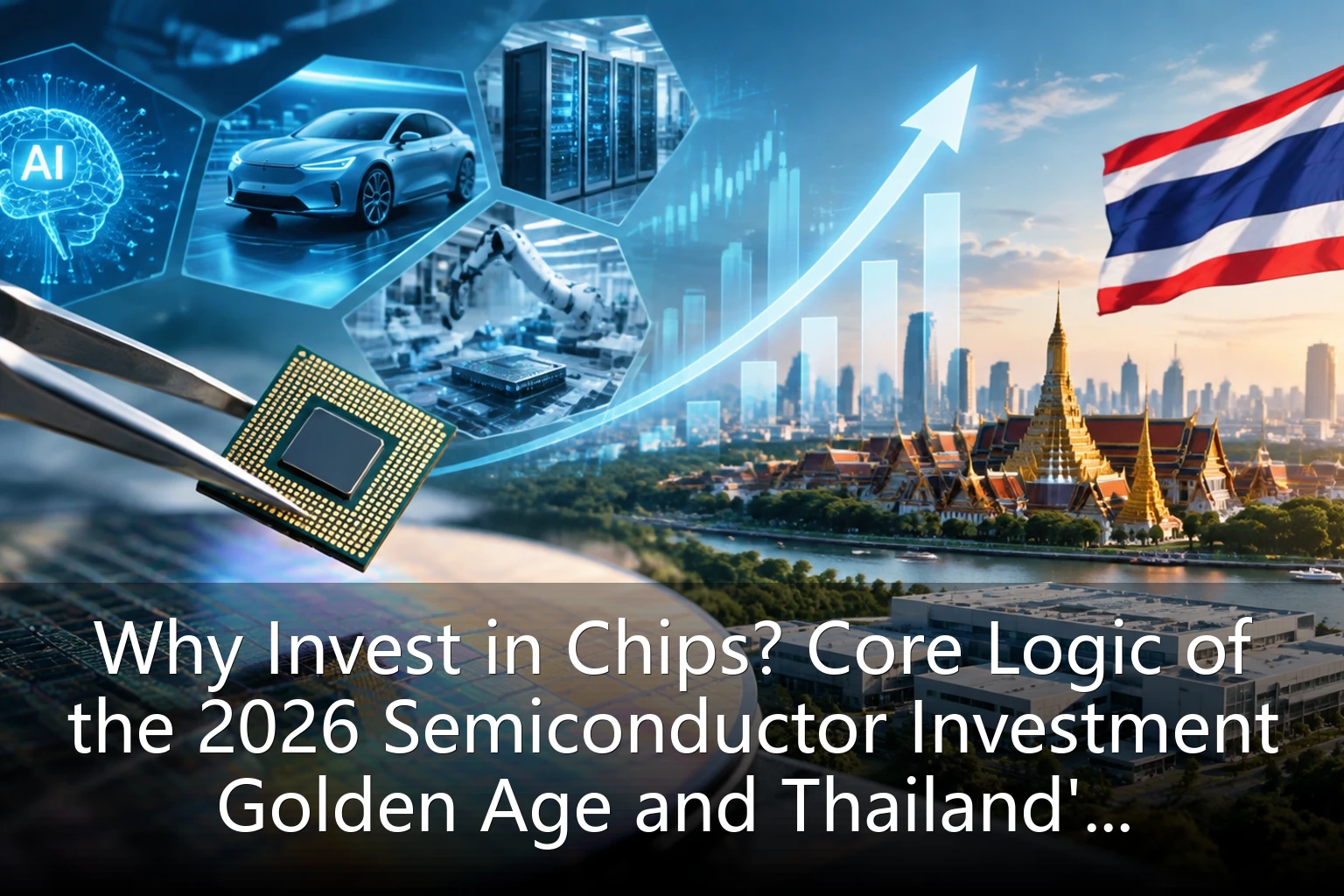
Amidst increasingly fierce global technological competition, the semiconductor industry, as the cornerstone of the information society, is facing unprecedented development opportunities. With the vigorous development of emerging technologies such as artificial intelligence, 5G communication, Internet of Things, and autonomous driving, chip demand is showing explosive growth. By 2026, the global semiconductor market size is expected to exceed the $1 trillion mark, with major economies such as China, the United States, Europe, and Japan elevating the semiconductor industry to national strategic importance. This article will deeply analyze why now is the golden age for investing in the semiconductor industry from multiple dimensions including industry trends, investment logic, and regional opportunities, and how the Thai market is becoming a new hot spot for semiconductor investment in Asia.
Global Semiconductor Market: The Arrival of the Golden Age
In 2026, the global semiconductor industry has entered a new growth cycle. According to the latest industry data, global semiconductor sales in the first half of the year increased by 23% year-on-year, with particularly significant growth in areas such as AI chips, automotive chips, and high-performance computing chips. This growth trend is mainly driven by three major forces: first, the acceleration of digital transformation has led to continuous growth in chip demand across industries; second, the iteration of emerging technologies has created new chip demands; third, the restructuring of the global supply chain has shown obvious trends of regionalization and localization.
At the technological level, continuous breakthroughs in advanced processes, advanced packaging, and heterogeneous integration are driving continuous improvement in chip performance. Leading manufacturers such as TSMC and Samsung have mass-produced 3nm processes and are actively planning 2nm and below processes. Meanwhile, Chiplet technology is gradually maturing, bringing more flexibility and cost-effectiveness to chip design. These technological advancements not only improve chip performance but also bring new investment opportunities to the semiconductor industry.
AI Chips: The Core Growth Point of Semiconductor Investment
The rapid development of artificial intelligence technology has become the biggest growth engine for the semiconductor industry. In 2026, the global AI chip market size is expected to reach $200 billion, with a compound annual growth rate exceeding 30%. From GPUs for training large models to NPUs for edge computing, AI chips are penetrating various application scenarios. Traditional chip giants such as NVIDIA, AMD, and Intel, as well as numerous startups, are increasing their R&D investment in AI chips, forming a competitive landscape.
Notably, the AI chip market is showing a diversified development trend. On one hand, the demand for high-performance training chips continues to grow, driving demand for advanced process chips; on the other hand, niche markets such as edge AI chips and low-power AI chips are rapidly emerging, providing more diversified choices for semiconductor investment. Investors can focus on companies with core competitiveness in AI chip design, manufacturing, and packaging.
Core Logic of Semiconductor Investment
Accelerated Domestic Substitution with Strong Policy Support
Against the backdrop of global semiconductor supply chain restructuring, countries are strengthening support for their domestic semiconductor industries. China has launched the "Big Fund III" with a scale exceeding 300 billion yuan, focusing on supporting key links such as semiconductor equipment and materials; the United States has passed the "CHIPS and Science Act", investing $52 billion to support domestic semiconductor manufacturing; the EU has launched the "European Chips Act", planning to invest 43 billion euros to increase semiconductor production capacity; Japan, South Korea and others have also successively introduced supporting policies.
This policy support not only provides financial security for the semiconductor industry but also creates a favorable development environment. Especially in China, semiconductor domestic substitution has entered an acceleration period, with domestic enterprises gradually achieving technological breakthroughs and market expansion in all aspects from design, manufacturing to packaging and testing, equipment, and materials. This trend provides a clear direction and huge market space for semiconductor investment.
Huge Market Space and High Industrial Chain Value
As the cornerstone of the information society, the semiconductor industry has wide application fields and huge market space. From consumer electronics to industrial control, from automotive electronics to medical equipment, from communication equipment to artificial intelligence, almost all high-tech fields rely on chip support. With the deepening of digital and intelligent transformation, chip demand will continue to grow.
At the same time, the semiconductor industry chain is long and valuable, covering multiple links such as design, manufacturing, packaging and testing, equipment, and materials, each containing rich investment opportunities. Especially in key links such as advanced processes, special processes, advanced packaging, semiconductor equipment, and materials, there are high technical barriers and large profit margins, showing significant investment value.
Thailand's Semiconductor Industry: A New Investment Hotspot in Asia
Policy Dividends and Industrial Upgrading
In recent years, the Thai government has listed the semiconductor industry as a key development area, actively attracting foreign investment and local enterprise investment through various policies such as tax incentives, land support, and talent training. The new plan introduced by the Thailand Board of Investment (BOI) provides up to 8 years of corporate income tax exemption for semiconductor projects and exempts import duties on machinery, equipment, and raw materials. These policy dividends have significantly reduced corporate investment costs and improved return on investment.
At the same time, Thailand is actively promoting the upgrading of the semiconductor industry, extending from traditional packaging and testing to high-value-added links such as design and manufacturing. Thailand's EEC (Eastern Economic Corridor) has become a semiconductor industry cluster, attracting many international semiconductor giants to invest and set up factories. With the advancement of industrial upgrading, Thailand's semiconductor industry chain is becoming increasingly complete, and the investment environment is continuously improving.
Location Advantages and Supply Chain Synergy
Thailand has unique location advantages in the Southeast Asian region, located at the center of ASEAN, serving as a hub connecting China, India, and other Southeast Asian countries. This location advantage makes Thailand an important node in the semiconductor industry supply chain, effectively connecting with the global semiconductor industry chain.
In addition, Thailand has a mature electronics industry foundation, with developed automotive electronics and consumer electronics industries, providing a broad application market for the semiconductor industry. At the same time, the Thai government is actively promoting the "Thailand 4.0" strategy, vigorously developing the digital economy and intelligent industries, creating a favorable application environment for the semiconductor industry.
Investment Strategies and Risk Analysis
Investment Directions and Target Selection
In the field of semiconductor investment, investors can focus on the following directions: first, the AI chip industry chain, including chip design, manufacturing, and packaging; second, automotive chips, with the development of automotive electrification and intelligence, automotive chip demand continues to grow; third, semiconductor equipment and materials, which are the foundation of the semiconductor industry, with large space for domestic substitution; fourth, special process chips such as power semiconductors and MEMS, with wide application fields and large market space.
When selecting investment targets, attention should be paid to indicators such as the company's technical strength, market position, profitability, and growth potential. Especially in the Thai market, companies with layouts in the EEC area and local companies with core technical advantages can be focused on. At the same time, investors should also pay attention to the company's financial condition to avoid blindly chasing high valuations.
Risk Analysis and Response Strategies
Semiconductor investment also faces certain risks, mainly including technology iteration risks, market competition risks, policy change risks, and supply chain risks. In terms of technology iteration, semiconductor technology updates quickly, and companies that cannot continuously innovate may face the risk of being eliminated; in terms of market competition, the semiconductor industry is highly concentrated, with leading companies having obvious advantages, and small and medium-sized enterprises facing great pressure; in terms of policy changes, countries' semiconductor policies may be adjusted, affecting the industrial development environment; in terms of supply chain, the global semiconductor supply chain is complex and easily affected by factors such as geopolitics.
In response to these risks, investors can adopt the following strategies: first, diversify investments, not concentrating funds in a single company or single link; second, long-term investment, the semiconductor industry is cyclical, and long-term holding can smooth cyclical fluctuations; third, pay attention to technological development trends, choose companies with continuous innovation capabilities; fourth, closely follow policy changes and adjust investment strategies in a timely manner.
Conclusion: Seizing the Golden Age of Semiconductor Investment
As the cornerstone of the information society, the semiconductor industry is in a golden development period. The rapid development of emerging technologies such as AI, 5G, Internet of Things, and autonomous driving has provided broad market space for the semiconductor industry. At the same time, the restructuring of the global semiconductor supply chain and strong policy support from various countries have created a favorable environment for semiconductor investment.
With advantages in policy dividends, location advantages, and industrial foundation, Thailand is becoming a new hotspot for semiconductor investment in Asia. Investors can pay attention to the development opportunities of Thailand's semiconductor industry, especially investment opportunities in fields such as AI chips, automotive chips, and semiconductor equipment and materials.
Of course, semiconductor investment also faces certain risks. Investors need to conduct sufficient research and risk assessment and formulate reasonable investment strategies. Overall, as the core of the high-tech field, the semiconductor industry has long-term investment value and deserves the attention and layout of investors.
In this era of technological change, seizing the opportunities of semiconductor investment is seizing the commanding heights of future technological development. Whether individual investors or institutional investors, they should fully recognize the importance of the semiconductor industry, actively layout this golden track, and share the dividends of technological development.