



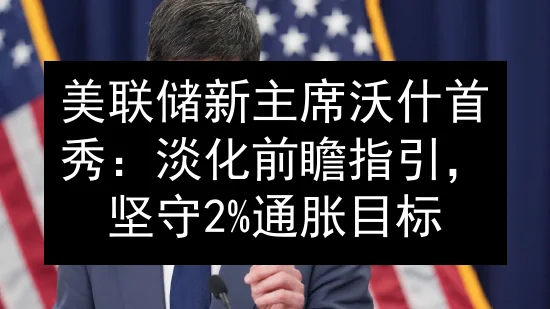
Fed's new chair Warsh debut: downplays forward guidance, stands by 2% inflation target
At 2:00 a.m. Beijing time on June 18, the Fed announced it would keep the federal funds target range unchanged at 3.5% to 3.75%, marking the fourth straight meeting without action this year and matching broad market expectations.
The post-meeting statement said officials still considered inflation elevated and reiterated their commitment to price stability. At the same time, economic growth was still described as “solid,” and productivity growth and capital investment were said to remain strong. The statement was noticeably shorter than before, which many saw as a signal that the Fed's communication strategy may be changing.
Policymakers also revised several March economic projections: this year's median inflation forecast was raised from 2.7% to 3.6%, and the 2026 core inflation forecast was raised from 2.7% to 3.3%; the median 2026 growth forecast was cut from 2.4% to 2.2%, and the median unemployment forecast for the end of 2026 was lowered from 4.4% to 4.3%.
After his first policy meeting in office, Fed Chair Warsh said restoring price stability was the top priority. At the press conference, he stressed that persistently high prices are a burden on Americans, but that the FOMC will work to achieve price stability.
Warsh also downplayed the importance of the latest rate forecasts. The dot plot showed that 9 of the 19 officials expected at least one hike this year, including 6 who expected at least two hikes; another 9 expected rates to stay unchanged or be cut. He also said many officials acknowledged the outlook was highly uncertain and that the committee had a “healthy internal debate” over the rate path.
The new chair, a long-time critic of “forward guidance,” made clear that he would not submit a rate forecast and that he believed the dot plot was of limited help in policy implementation.
The dot plot showed that among the 18 officials who submitted forecasts, 1 thought a cumulative 75-basis-point hike was appropriate for the rest of 2026, 5 thought 50 basis points, 3 thought 25 basis points, 8 thought rates should stay unchanged, and 1 thought a cumulative 25-basis-point cut was appropriate.
Signals of a new Fed communication framework
Warsh signaled a clear communications overhaul at the press conference: the Fed has already abandoned forward guidance and cannot make forward-looking commitments about specific actions in the future. He said press conferences remain useful, but may need to be adjusted, and that a new communication framework could be unveiled before year-end.
Standing by the 2% inflation target and guarding against second-round effects
On the inflation target, Warsh stressed that 2% remains the Fed's long-term goal and there is no reason to reassess it before the target is achieved. He said the Fed cannot directly affect price moves in sectors such as energy that are caused by supply shocks, and its core job is to prevent “second-round” inflation effects.
Warsh also noted that most of the data the Fed relies on now comes from outdated survey methods, another area that needs reform.
Five special task forces set up to push institutional reform
To address current challenges, Warsh announced five special task forces in the monetary policy field and said most of their work should be finished by year-end. Their focus will be communications, the balance sheet, data sources, productivity and employment. The productivity group will specifically examine how artificial intelligence affects productivity, while the inflation group will study the drivers of inflation.
Independence and external relations
Warsh stressed that the Fed would never hand decision-making power to any outside person, defending the central bank's independence. He also disclosed that he has had breakfast with Treasury Secretary Scott Bessent three times and has met with the Fed inspector general, who is expected to release a report this summer on the renovation of the Fed building.
On market pricing, Warsh said the market performs best when it reacts to real-time data, and market prices themselves may be the most important reference.
Market reaction: swings in equities, FX, bonds and oil
As of the June 18 close, U.S. stocks broadly fell on Wednesday, with the Dow down about 500 points, tech leaders leading losses, and Treasury yields surging. The Dow fell 507.12 points, or 0.98%, to 51,492.55; the Nasdaq fell 354.68 points, or 1.34%, to 26,021.65; and the S&P 500 fell 91.25 points, or 1.21%, to 7,420.
Oil prices edged higher after two straight days of sharp losses, but the prospect of a temporary peace deal between the U.S. and Iran still weighed on prices. WTI crude rose 1% to close below $77 a barrel, while Brent settled below $80 a barrel.
The dollar index posted its biggest gain in three months. The dollar rose 0.14% against the yen to 160.65, with the yen hitting its weakest level since July 2024; sterling fell 0.99% to $1.3293, and the euro fell 0.92% to $1.1501.
In the U.S. bond market, short-term Treasuries sold off sharply and the yield curve flattened sharply. The 2-year Treasury yield briefly rose 15 basis points to 4.20%, the highest since February 2025, reflecting a repricing of rate-hike expectations.
Institutional views: clearly hawkish
Natixis said the meeting was hawkish overall: rates were left unchanged, the easing bias was removed, there were no dissents, and the statement was clearly trimmed, ending with a commitment to achieve price stability.
Goldman Sachs Asset Management analysts said today's decision shows the Fed's recent hawkish shift is not only about energy prices. Even though oil has pulled back recently, half of FOMC members expect a hike as early as this year, and the importance of upcoming inflation data will rise further.
Nick Timiraos, the so-called “Fed whisperer,” said this dot plot had a clearly hawkish tilt, and the policy statement was comprehensively rewritten from start to finish, with the text also much shorter, so market expectations for the rate path may need to be reset.

