


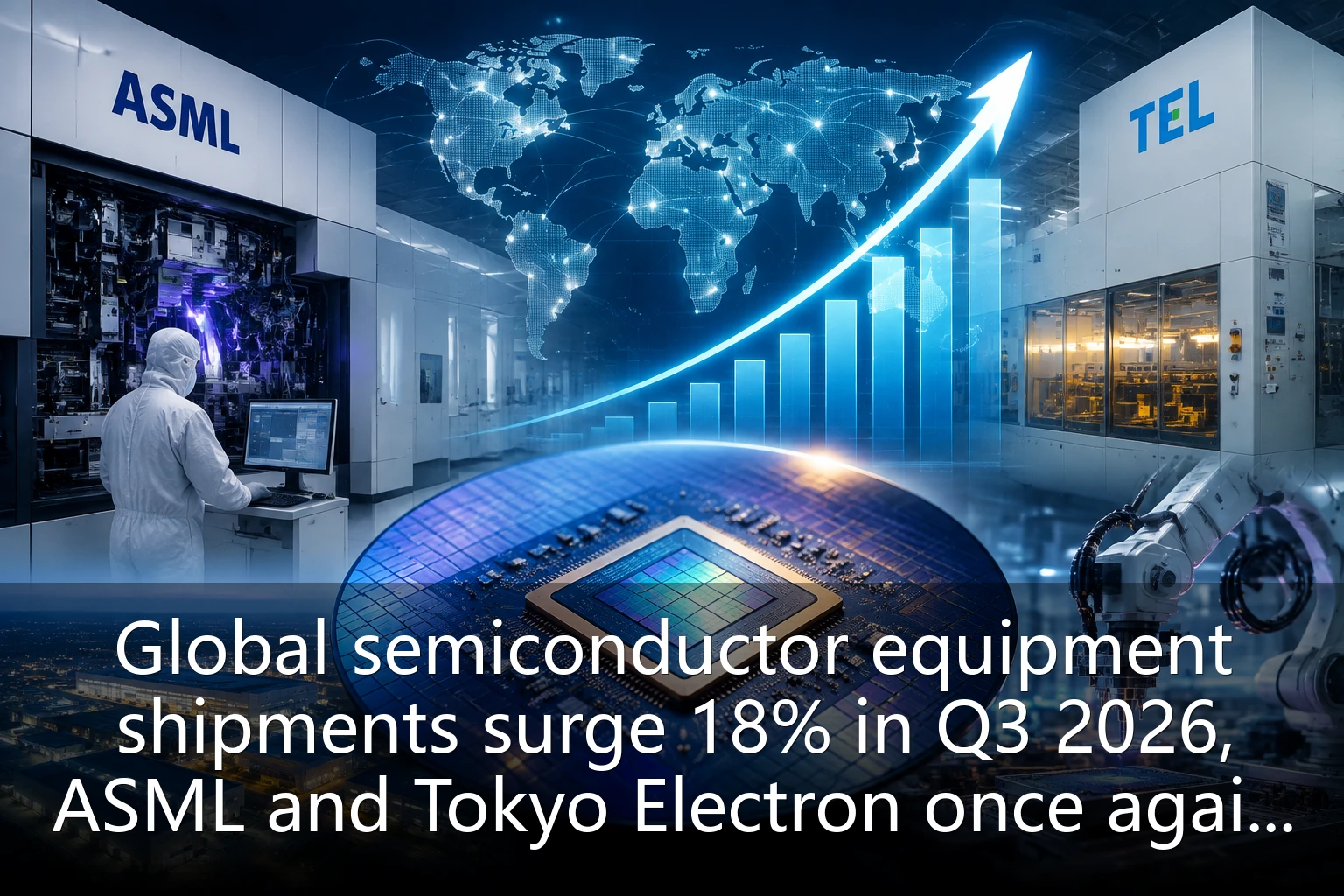
AI arms race ignites equipment demand, semiconductor equipment shipments hit nearly three-year high
August 4, 2026 – According to the latest data disclosed by SEMI and several top equipment manufacturers, global semiconductor equipment shipments in Q3 2026 are expected to exceed the $31 billion mark, surging 18% year-on-year and setting the highest single-quarter growth since Q4 2023. This strong momentum has completely shattered the previous conservative market expectation that "semiconductor capital expenditure has peaked," marking the official entry of the global chip industry into a "hardcore expansion deep-water zone" driven by artificial intelligence (AI).
Unlike previous equipment cycles dominated by memory chips or smartphones, this surge in equipment shipments exhibits highly distinct structural characteristics. As the AI model arms race among tech giants like OpenAI, Google, and Meta intensifies, computing power demand is growing exponentially, leading TSMC, Samsung, and Intel to aggressively expand their advanced process and advanced packaging capacities. In particular, the trial production of sub-2nm processes and the widespread adoption of Chiplet heterogeneous integration technology have directly fueled massive demand for extreme ultraviolet (EUV) lithography equipment and high-precision etching and deposition tools.
Equipment duos beat expectations, lead times extend to 18 months
Dutch lithography giant ASML and Japan's Tokyo Electron (TEL) both provided Q3 performance guidance in their recent earnings reports that far exceeded Wall Street expectations. ASML's net bookings surged to €8.5 billion in Q2, with EUV lithography orders alone accounting for over 60%, reflecting that logic chip foundries' layout for sub-2nm processes is frantically absorbing capacity. Meanwhile, Tokyo Electron's revenue in the etching and thin-film deposition equipment sectors also hit a record high, with management stating during the earnings call that "AI-driven semiconductor investment is rewriting the cyclical laws of the industry."
However, behind the booming orders lies an increasingly severe supply chain bottleneck. According to industry data cited by the Thailand Semiconductor Industry Association (TCEB), the average lead time for key semiconductor equipment has further extended from 12 months at the end of 2025 to over 18 months. Some high-precision die bonders and photoresist coating and developing equipment used in advanced packaging are even experiencing ultra-long waiting periods of over 24 months. This supply-demand imbalance has made the second-hand equipment market exceptionally hot, with refurbished equipment prices rising 15% in the past six months, prompting many small and medium-sized chip design firms to turn to capacity leasing or third-party foundry services.
Advanced packaging becomes Thailand's opportunity: back-end equipment investment heats up
Amid the surge in equipment shipments, a highlight that cannot be ignored is the explosive demand for advanced packaging equipment. As AI chips evolve from single chips to system-in-package (SiP) and Chiplet architectures, the technical value added in the packaging stage is no less than that of front-end manufacturing. Although TSMC's CoWoS capacity has doubled in 2026, it still cannot meet the order demands from NVIDIA and AMD, forcing second-tier packaging and testing manufacturers to accelerate expansion.
For Thailand's semiconductor industry, this represents a critical window to capture the spillover benefits of the industry chain. The new incentives recently approved by the Thailand Board of Investment (BOI) for the semiconductor cluster in the Eastern Economic Corridor (EEC) have successfully attracted several global leading packaging equipment manufacturers to establish after-sales service centers and refurbishment plants in Thailand. Industry insiders revealed that a major Japanese packaging equipment manufacturer is planning to invest in a technical center in Chonburi Province to meet the growing demand for advanced packaging equipment maintenance and modification in Southeast Asia. This not only helps shorten the equipment acquisition time for local packaging test plants in Thailand but also draws significant attention from capital to related semiconductor supply chain stocks in the Thai SET market.
Capital expenditure and geopolitics: the wave of equipment autonomy
While equipment shipments are climbing, the shadow of geopolitics still looms over the semiconductor equipment market. The continued tightening of US export controls on China has prompted Chinese semiconductor manufacturers to procure non-US equipment at an unprecedented pace and accelerate domestic substitution. This has, to some extent, diverted global equipment capacity and led to a rapid increase in the market share of Japanese and Korean equipment manufacturers in the Asian market. Furthermore, the South Korean government's recently announced "K-Semiconductor 2.0" strategy, which plans to invest massive funds to subsidize domestic equipment research and development, has further intensified the global competition for core components.
Analysts point out that the current high growth in semiconductor equipment is not a flash in the pan. As AI computing permeates from the cloud to the edge and the demand for silicon carbide (SiC) power semiconductors in electric vehicles explodes, the long-term logic for equipment investment remains solid. However, investors should also be wary of short-term inventory adjustment risks caused by excessive capacity concentration. Overall, the semiconductor equipment market in the second half of 2026 serves as the most important barometer for observing the global chip industry's prosperity.

