


Good, as a professional content creator, I will craft a well-structured and in-depth professional article based on the reference content you provided.
Semiconductor equipment delivery cycle continues to lengthen: Supply chain dilemma and new normal under global expansion wave
Keywords: Semiconductor equipment, delivery cycle, supply chain, wafer fab expansion, capital expenditure, industry outlook
Introduction: The flip side of prosperity – ever-lengthening wait
The global semiconductor industry is undergoing an unprecedented expansion cycle. From advanced logic chips to high-bandwidth memory and various power semiconductors, explosive demand growth, especially the computing power revolution brought by artificial intelligence (AI), is driving major wafer fabs to launch a new wave of capacity construction worldwide. However, behind this 'fab building spree,' an increasingly severe challenge is emerging: the delivery cycle of semiconductor manufacturing equipment is significantly lengthening.
According to the latest news on July 24, 2026, the surge in equipment orders has overwhelmed the global supply chain. For chip manufacturers planning capacity, timely equipment arrival has become a critical variable determining project success. This is not just a temporary logistics issue but a complex topic reflecting structural supply-demand imbalance that profoundly impacts the industry's future direction.

Main text: Delivery times double, a perfect supply-demand storm
1. When 'waiting for equipment' becomes the norm: current status of delivery delays
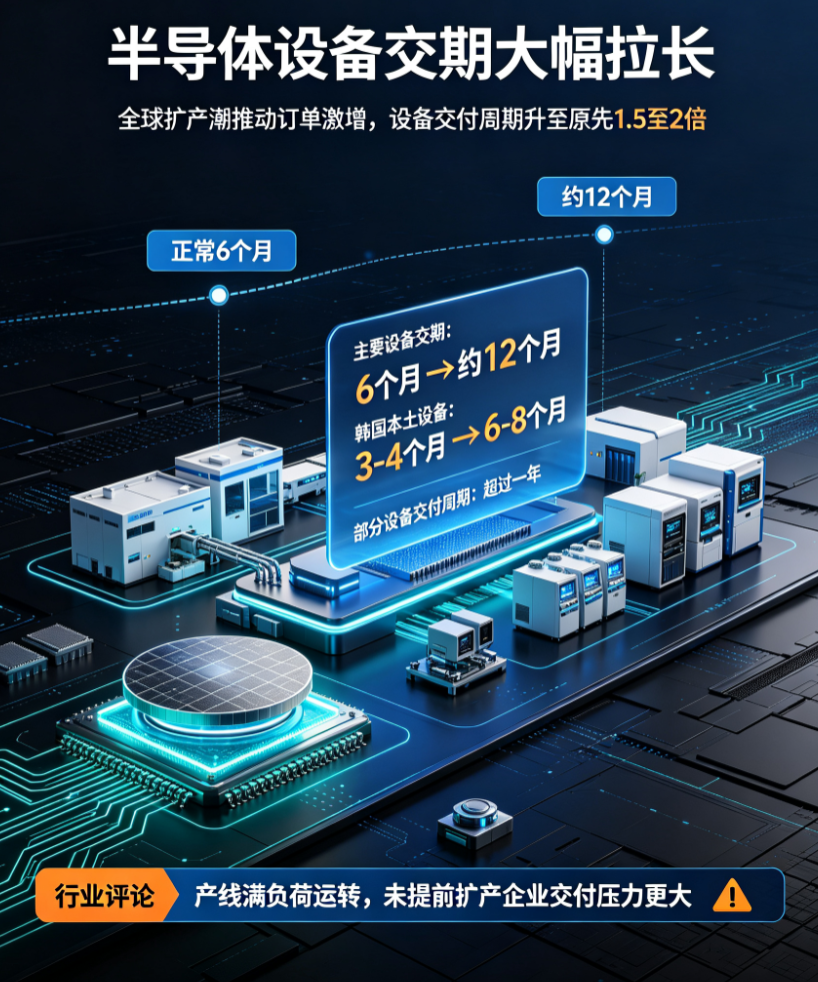
According to South Korean media reports, the five major players in the semiconductor equipment field – Applied Materials, ASML, Lam Research, Tokyo Electron, and KLA – have seen their core equipment delivery cycles generally extended to 1.5 to 2 times normal levels. Previously, customers typically had to wait about six months from order to delivery for a lithography or etching system. Now, this cycle has stretched to an astonishing year or even longer.
This tense situation is not limited to international giants. South Korean domestic semiconductor equipment suppliers also face severe challenges. For example, a Korean company supplying both front-end and back-end equipment to TSMC and Micron Technology has seen delivery times for some equipment increase from 3-4 months to 6-8 months. Another company providing back-end packaging and testing equipment to Micron has seen its delivery times expand by about 1.5 times. Worse still, delivery cycles for some specific equipment have completely gone out of control, with scheduling exceeding one year.
An anonymous senior executive in the semiconductor equipment industry admitted: 'Even those equipment manufacturers that had the foresight to pre-book capacity and components are now running their production lines at full capacity, and delivery times are still lengthening. For companies that failed to plan ahead for expansion, facing the overwhelming wave of orders, delivery delays have become almost routine.'
2. Cause analysis: From pandemic logistics woes to structural investment drivers
The root cause of the current tight delivery cycles differs from the previous crisis in 2021-2022. At that time, global supply chain chaos mainly stemmed from logistics disruptions, port congestion, and labor shortages caused by the COVID-19 pandemic, typical of a 'supply chain shock.' However, the core driver of the current delivery delays is deeper and more sustainable – major semiconductor manufacturers are pushing forward their large-scale wafer fab investment plans with unprecedented intensity and scale.
From TSMC's global deployments in Arizona (USA), Kumamoto (Japan), and Dresden (Germany), to Samsung Electronics' mega-factory in Texas, and to SK Hynix and Micron's multi-trillion-dollar investment commitments in memory chips, each new wafer fab signifies billions of dollars in equipment procurement demand. When so many 'super projects' simultaneously enter the equipment procurement phase, it creates a massive suction effect on the capacity of the few key global equipment suppliers. This demand-side explosion driven by 'investment fever' is the fundamental cause of the current delivery dilemma.
3. Butterfly effect: How equipment delays reshuffle the industry landscape
The impact of equipment not arriving on time is chain-like and systemic. For wafer fabs, equipment is 'ammunition'; if the ammunition is delayed in reaching the front line, the entire 'battle' (new fab ramp-up) rhythm will be disrupted. Delayed production not only means huge sunk costs and longer ROI cycles but may also cause companies to miss critical windows in fierce market competition.
Facing this situation, industry giants have started acting proactively. The procurement departments of Samsung Electronics and SK Hynix are closely monitoring equipment supplier delivery status and actively studying countermeasures. According to industry insiders, to prevent equipment delivery delays from hindering new fab construction schedules, these two South Korean semiconductor giants plan to significantly advance their procurement order submission times, and may even adopt more flexible strategies like 'bulk booking' or 'rolling orders' to lock in scarce capacity. This 'early ordering' behavior can to some extent further exacerbate short-term supply-demand imbalance, creating a self-reinforcing cycle.
Industry experts generally expect that as global semiconductor manufacturers continue to expand capacity, equipment delivery cycles will continue to lengthen for some time, with no clear turning point in the near term. This tight situation has even begun to spread to more upstream areas; various facilities, specialty gases, high-purity chemicals, and utility equipment needed for wafer fab construction may all face supply tightness and price pressures.
4. Outlook: Capex frenzy and long-term optimistic expectations
Despite pain in the delivery phase, driven by huge profits and strategic prospects, the investment enthusiasm of global semiconductor giants shows no sign of abating.
Micron Technology recently announced a significant increase in its long-term investment plan for new U.S. factories from $200 billion to $250 billion, aiming to meet the 'unprecedented' memory chip demand driven by AI infrastructure expansion. Similarly, TSMC has raised its full-year 2026 capital expenditure plan to $60-64 billion, a year-over-year increase of 51.6%. Of this massive investment, about 70-80% will be used for advanced node expansion (e.g., 3nm, 2nm and below), about 10% for specialty nodes, and 10-20% for key support areas such as advanced packaging, testing, and photomask manufacturing. This 'real money' is flowing directly into equipment procurement.
Recently, the Semiconductor Equipment Association (SEMI) released its 'Mid-Year Total Semiconductor Equipment Market Forecast Report,' painting a magnificent picture for the industry. The report predicts that total global semiconductor manufacturing equipment sales will reach a record high of $165.9 billion in 2026, a 23.2% year-over-year increase. More excitingly, this strong growth momentum is expected to continue through 2028, with total equipment sales expected to reach a record $229.5 billion, achieving five consecutive years of steady growth.

Behind this forecast is the continuous explosion of downstream applications such as AI, high-performance computing, the Internet of Things, and automotive electronics, along with huge demand for the computing infrastructure of the future digital world. The extension of equipment delivery cycles is essentially a 'growing pain,' reflecting the temporary mismatch between the strong momentum of industrial development and existing supply capacity.
Conclusion: Seeking long-term development amid 'slow delivery'
In summary, the current widespread extension of semiconductor equipment delivery cycles is not a short-term failure of supply chain management, but an inevitable product of the global semiconductor industry being in a 'super investment cycle.' It is both a challenge and a signal of industry structural upgrade.
For chip manufacturers, this means the tests of project management, supply chain resilience, and strategic planning capabilities become unprecedentedly important. They need to shift from 'on-demand procurement' to 'strategic foresight,' build deeper partnerships with equipment manufacturers, and even jointly invest in capacity expansion. For equipment suppliers, prolonged delivery cycles bring both order prosperity and delivery commitment pressure, forcing them to accelerate their own capacity construction and diversify supply chain.
Looking ahead, although the short-term pain of 'waiting for equipment' will persist, in the long run, this industrial wave driven by AI and advanced computing will bring unprecedented development opportunities to the entire semiconductor ecosystem. How to navigate this structural trend of 'slow delivery but fast prospects' will become the core proposition determining the competitiveness of semiconductor companies in the coming years. The new normal of the semiconductor industry may be finding a new balance between booming growth and tight supply chains.

