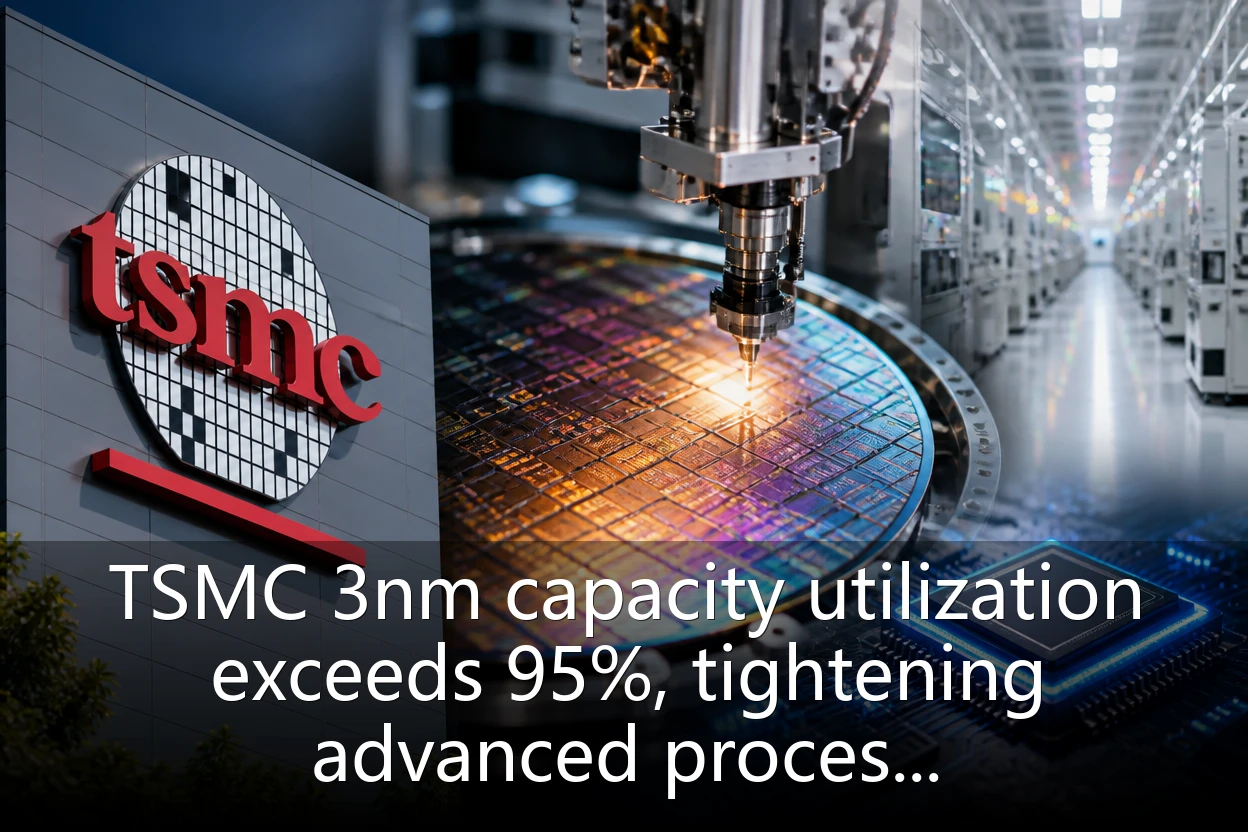
AI Demand Devours Capacity: TSMC's 3nm Node Nears Full Loading
According to multiple supply chain consultancies and internal semiconductor industry sources, in early August 2026, global foundry leader TSMC's most advanced 3nm process node capacity utilization had breached the 90% mark, with some core production lines even reaching full loading levels above 95%. This data signals that since the process entered mass production in 2024, its supply-demand relationship has officially entered a new phase of extreme tightness. Sources indicate the primary reasons for the capacity crunch are the non-linear explosion in global artificial intelligence (AI) computing demand and the early arrival of the flagship product stocking season for major smartphone chip design companies.
AI Training and Inference Chips Become a 'Capacity Black Hole'
In the 2026 semiconductor landscape, AI chips have become the undisputed largest buyer of advanced processes. NVIDIA's next-generation GPUs based on the Blackwell architecture, AMD's Instinct series accelerators, and proprietary AI ASICs (Application-Specific Integrated Circuits) from major cloud service providers are all voraciously consuming 3nm wafer capacity. As AI model parameters continue to balloon, single chip die sizes and transistor counts surge, the number of good dies that can be diced from each wafer relatively decreases, further intensifying the scarcity of unit capacity. An anonymous semiconductor analyst noted: "Today's AI chips are getting larger and demand extremely high yields. A single 3nm wafer often yields only half the number of high-end logic chips it used to, meaning actual capacity supply is far below planned paper capacity."
Smartphone and PC Demand Resonates, Capacity Squeeze Effects Emerge
Beyond AI server-side demand, the consumer electronics sector also entered a pull-in cycle ahead of new product launches in the second half of 2026. Apple's upcoming A20 Bionic chip and M6 series computer processors have already locked in substantial 3nm capacity, while Qualcomm and MediaTek's next-gen 5G flagship basebands and processors are also actively vying for windows. This dual demand overlay from AI and consumer electronics directly creates a strong capacity squeeze effect. For smaller chip design houses, securing sufficient 3nm capacity support is becoming increasingly difficult, with some orders even forced to delay or shift to the higher-cost N3P enhanced process.
Advanced Process Supply Tightness May Extend into 2027
Facing surging orders, TSMC has moved to accelerate the production ramp of its new fab in the Southern Taiwan Science Park and plans to add approximately 15% more 3nm and advanced N3E process capacity by the end of 2026. However, while semiconductor equipment lead times have shortened compared to 2024, high-end extreme ultraviolet (EUV) lithography machines still face supply bottlenecks. Industry experts predict that even as new capacity gradually comes online, the supply tightness for 3nm and more advanced 2nm processes will persist at least through the first half of 2027. This supply-demand imbalance not only grants TSMC stronger pricing power but also signals that the cost of end AI servers and high-end smartphones is unlikely to drop significantly in the short term.
Ripple Effects on Thailand's Semiconductor Industry Chain
TSMC's full-load operation of advanced processes has profound ripple effects across the entire Asian semiconductor supply chain. In Thailand, as advanced node capacity centralizes, a large volume of mature process and associated packaging and testing orders is accelerating its shift to Southeast Asia. Data recently released by the Thailand Board of Investment shows that foreign direct investment applications related to semiconductors in Thailand grew 35% year-on-year in the first half of 2026, with the majority concentrated in advanced packaging, testing, and semiconductor equipment component manufacturing. This provides solid fundamental support for the SET semiconductor sector, and those Thai local enterprises possessing high-end packaging technology or tightly bound to TSMC's supply chain are ushering in a dual recovery period for both performance and stock prices.