


Global Semiconductor Equipment CapEx Uptrend Begins; Localization Logic Reinforced
Keywords: Semiconductor Equipment; CapEx; Localization; SEMI; Supply Chain Tightness
Introduction: New Momentum Behind Market Outperformance
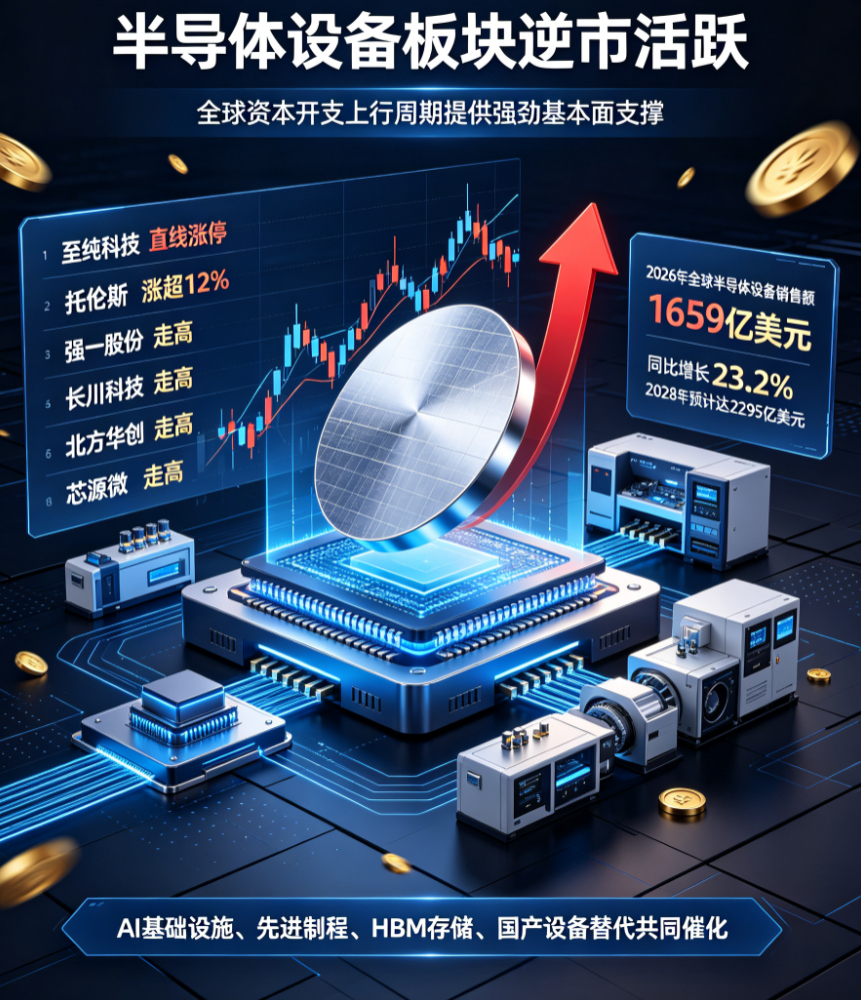
On July 24, 2026, the A-share semiconductor equipment sector outperformed the market, becoming one of the few bright spots. Zhicheng Technology (603690.SH) hit the daily limit up; Tuolunsi (301583.SZ) rose over 12%; Qiangyi (688809.SH), Changchuan Technology (300604.SZ), NAURA (002371.SZ), and Kingsemi (688037.SH) rallied together, showing strong capital interest. This movement is not isolated sentiment but a reflection of the global semiconductor CapEx upcycle's fundamental support in secondary markets. From a medium- to long-term perspective, the semiconductor equipment sector is facing new structural opportunities, and the dual logic of localization and overseas expansion is expected to strengthen.

I. Global Semiconductor Equipment Market: Clear Expansion; AI & Memory Drive Growth
According to the latest report from SEMI, the global semiconductor equipment market is entering a new high-growth phase. SEMI forecasts global semiconductor equipment sales will grow 23.2% YoY to $165.9 billion in 2026, and could reach a record $229.5 billion by 2028. This trajectory surpasses earlier expectations, driven by multiple structural forces.
SEMI highlights the continued expansion of AI infrastructure as the primary driver. With exponential growth in large model training and inference demand, demand for advanced logic chips, HBM, and dedicated AI accelerators is surging, directly boosting wafer fab equipment purchases. Wafer fab equipment market size is expected to reach $200 billion by 2028, driven by AI-related production capacity expansion and accelerated transition to advanced manufacturing processes (e.g., 3nm and below). Meanwhile, memory chips are seeing a new investment cycle—Samsung, SK Hynix, and Micron are ramping up CapEx in HBM and next-gen DRAM/NAND, further solidifying equipment demand resilience.
Notably, SEMI's data release coincided with a phase of pullback in the global semiconductor sector, making its optimistic forecast more significant. The market's delayed reaction provides a window for medium- to long-term positioning.
II. Short-Term Pullback Releases Risk; Institutions See Allocation Window
Since July, the global semiconductor sector has experienced a notable pullback, causing some investor doubt. However, Galaxy Securities states in its latest report that the pullback is not due to fundamental negatives but technical factors such as deleveraging, profit-taking in memory, and valuation normalization for some stocks. Current sector valuations have largely de-risked, with some core stocks' P/E ratios falling to historical mid-low levels.
Galaxy Securities recommends focusing on expansion-related sub-sectors: advanced packaging, foundry, semiconductor equipment & materials, and domestic computing chain. These areas benefit from global CapEx expansion and have additional domestic self-sufficiency catalysts. In H2, with new international fabs starting production and domestic memory lines accelerating, equipment bidding is expected to intensify, providing substantive order support to relevant companies.
Historically, semiconductor equipment stocks lead CapEx cycles by 2-3 quarters. Current valuations of global equipment leaders like Applied Materials, Lam Research, and Tokyo Electron have retraced from previous highs, yet their order visibility remains 6-12+ months. This suggests the current pullback is not a fundamental turning point but offers a rare entry window for long-term investors.
III. Domestic Semiconductor Equipment: Strong Medium- to Long-Term Growth
China's domestic semiconductor equipment supply chain stands at the threshold of a historic opportunity. In its in-depth report, Industrial Securities states that both AI-driven explosive demand and technological catch-up mean domestic memory chains like Yangtze Memory and ChangXin Memory still have enormous development and CapEx room. Their expansion plans will bring significant increments to upstream equipment and materials companies.
Industrial Securities estimates that domestic memory CapEx alone could exceed RMB150 billion over the next three years, with equipment procurement >70%. Current penetration rates of domestic equipment in etching, thin-film deposition, cleaning, and testing remain low, presenting huge upside. Leading domestic equipment firms like NAURA and AMEC have achieved breakthroughs from 0 to 1; the next focus is scaling from 1 to N.
Looking longer term, gross and net margins of the global top-5 semiconductor equipment companies have steadily increased since 2010, without significant cyclical erosion. This indicates high barriers and concentration, with strong pricing power for leaders. In the current CapEx upcycle, downstream customers prioritize "delivery assurance" over price competition, so gross margins are likely trending upward. If domestic equipment firms can prove their delivery capability and reliability in this cycle, they may earn long-term trust and occupy more favorable ecological niches in the next cycle.
IV. Overseas Supply Chain Tightness Opens Dual Window for Domestic Equipment: Substitution & Export
Tight supply in the global semiconductor equipment market is creating rare incremental space for domestic firms. According to a report by China Galaxy Securities, global semiconductor component lead times have lengthened since 2026. Automotive-grade 32-bit MCU lead times exceed 52 weeks; SiC devices and analog ICs are at 25-40 weeks and 20-48 weeks respectively. Due to shortages of core components (RF power supplies, precision valves, high-precision sensors) and capacity saturation, lead times for mainstream front-end and memory-related equipment from overseas manufacturers have extended to 12-24 months, with some equipment even seeing price increases.
This situation directly impacts the expansion plans of memory giants like Samsung, SK Hynix, and Micron, who face the dilemma of "money but no equipment" and are forced to seek diversified equipment suppliers to secure capacity. CGS believes this offers domestic equipment firms dual opportunities: first, accelerated domestic qualification—with long overseas lead times, domestic fabs and memory plants are more willing to give domestic equipment a "trial chance," shortening the introduction cycle; second, an export window—some overseas customers, to ease supply bottlenecks, are proactively contacting Chinese equipment vendors, especially in mature nodes and specialty processes.
In terms of actual progress, firms like Zhicheng Technology, NAURA, and AMEC have obtained small batch orders from some overseas customers. Though small in scale, this marks a key breakthrough from lab to fab. If they can pass qualification and expand supply share, domestic equipment firms may truly break overseas monopoly and transition from local support to global competitors.
Conclusion: At the Starting Point of a New Cycle
Overall, the global semiconductor equipment industry is in the early stage of a CapEx upcycle driven by AI infrastructure, advanced logic chips, and HBM investment. The A-share semiconductor equipment sector's outperformance is not accidental but an initial market response to improving fundamentals. While short-term volatility exists, from a medium- to long-term perspective, the growth space for domestic equipment is vast: both deterministic demand from domestic memory expansion and substitution/export opportunities from overseas supply chain tightness.
For investors, the focus should be on the solidity of the long-term logic, not short-term fluctuations. From SEMI's optimistic forecast, to positive assessments by Galaxy Securities, Industrial Securities, and China Galaxy Securities, all point to one direction: semiconductor equipment stands at the start of a new cycle. In this process, domestic equipment firms with core technology, customer certification, and capacity expansion capability are likely to be the biggest beneficiaries. The market will eventually prove that those who dare to position during cycle troughs often reap the richest rewards.

