


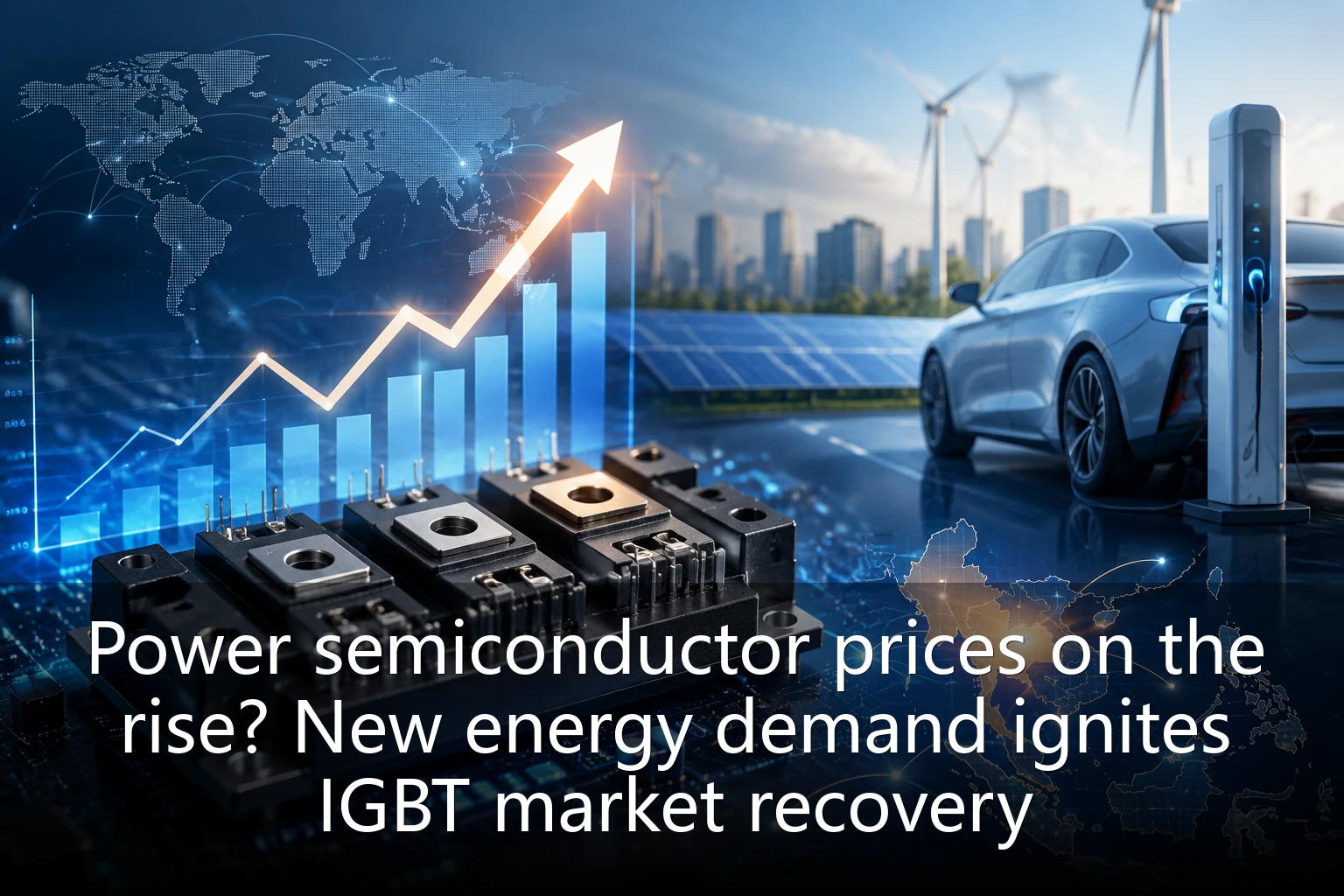
As global new energy vehicle penetration continues to climb, the power semiconductor sector, after a year-long deep correction, saw clear signs of a bottoming-out recovery in the second quarter of 2026. According to the latest data from TrendForce, average global IGBT module prices rose 2.1% quarter-on-quarter from April to June 2026, marking the first quarterly increase since Q3 2025. Meanwhile, spot price indices for power devices such as MOSFETs and rectifiers have stabilized, with some scarce models even commanding premiums of 3% to 5%.
Demand side: New energy and AI infrastructure as twin drivers
Demand for power semiconductors mainly comes from three areas: new energy vehicles, photovoltaic energy storage, and industrial drives. Among these, new energy vehicles represent the largest incremental market. Taking SiC power modules as an example, as Tesla, BYD, NIO and other automakers popularize 800V high-voltage platforms in mid-to-high-end models, the power semiconductor value per vehicle has risen from around $50 in traditional internal combustion engine vehicles to more than $500. On the photovoltaic inverter front, with global PV installations growing 25% year-on-year in the first half of 2026, demand for IGBT modules used in inverters has also risen accordingly.
Another noteworthy factor is the pull from AI data centers for power devices. Large AI servers consume up to tens of kilowatts, and their power supply units (PSUs) and power conversion chains require a large number of high-voltage FETs and rectifiers, contributing a completely new demand pole for power semiconductors.
Supply side: Inventory clearing and capacity tightness in tandem
Over the past two years, the power semiconductor industry has been troubled by high inventory. But as consumer demand continues to recover, channel inventory levels had largely returned to normal by Q1 2026. The latest quarterly reports from international giants such as Infineon, onsemi, and STMicroelectronics show that distributor inventory days have fallen to below 12 weeks, significantly lower than the 18 weeks seen in the same period last year. At the same time, wafer foundry capacity utilization is also rebounding, especially for 8-inch fabs where capacity for power products is nearly full, with lead times extended to 10–12 weeks, and some domestic manufacturers have begun to modestly raise quotations.
Technology trend: SiC moves from high-end to mainstream
In terms of technology roadmaps, third-generation semiconductor SiC is accelerating its penetration from the high-end market into mid-range vehicles. International majors have successively launched a new generation of automotive-grade SiC MOSFETs with lower on-resistance, while costs have fallen nearly 40% compared to five years ago. The industry expects SiC penetration in on-board main drive inverters to exceed 25% by 2027. Meanwhile, many manufacturers are exploring the use of GaN (gallium nitride) in data center power supplies and consumer fast charging, laying the groundwork for future growth.
Thailand and Southeast Asia: Benefiting from automotive electrification
Thailand, the largest automotive manufacturing base in Southeast Asia, is actively transforming into an electric vehicle hub. In the first half of 2026, domestic EV sales in Thailand grew 180% year-on-year, and the government has introduced a series of policies supporting local component processing. Against this backdrop, demand for automotive power semiconductors is spreading to Thailand's supply chain. In addition, the Thailand Board of Investment (BOI) has approved several international semiconductor manufacturers to set up power module packaging plants in Thailand, aiming to leverage local power and logistics advantages to form regional capacity for automotive chips.
Investment opportunities and risks
From an investment perspective, the power semiconductor sector in 2026 is characterized by both volume and price increases, leading to broadly upward revisions in earnings expectations for related companies. Investors can focus on two types of targets: first, global leaders in IGBT and SiC segments, which directly benefit from industry prosperity; second, packaging, testing, and materials companies closely tied to Southeast Asia's automotive industry, such as Thai local electronic component and PCB makers.
However, we must also be mindful of potential risks. The first is demand volatility: if global EV sales fall short of expectations, or PV installation slows, the upward cycle for power semiconductors may be delayed. The second is supply oversupply: as major manufacturers' expansion plans come to fruition, capacity could again become excessive in 2027. In addition, geopolitics and export controls may also affect supply chain layouts in specific regions.

